Warm Up:
Draw a system schema and a free body diagram for a car accelerating to the right across the ground.
Today:
- Finish the midterm review packet Solutions
- Any last questions?
Until Next Class: Be ready for the midterm next Tuesday.
 Class
39:
Wednesday, 1/7/25
Class
39:
Wednesday, 1/7/25Warm Up:
1
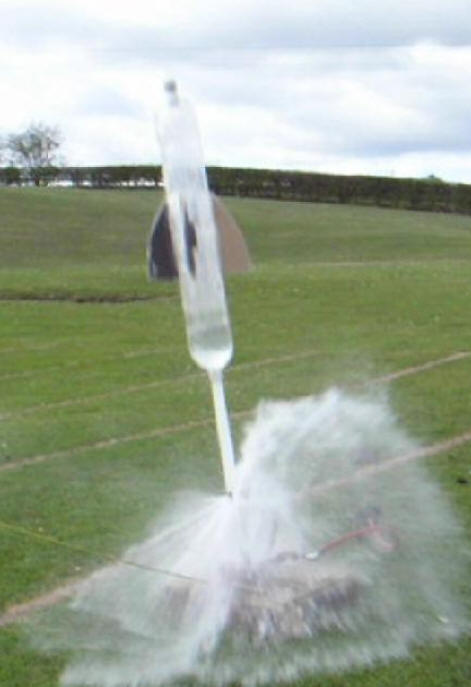
. Draw a system schema and a free body diagram for this water rocket that is accelerating upward. Do include the effects of air resistance.2. Why is it called a "free body diagram?"
Today:
- Continue to work through the midterm review packet Solutions
Until Next Class: Be ready for the midterm next Tuesday.
 Class
38:
Monday, 1/5/25
Class
38:
Monday, 1/5/25Warm Up: The 2nd diagram on the right is a System Schema representing the situation in the top diagram. The blocks are "objects of focus," labeled A, B, and C in the diagram. For simplicity, the creator of the diagram has assumed that the blocks are frictionless but the person is still pushing them somehow.
1. What is a system, in Physics?
2. What does a system schema show? In a system schema, how are the "objects of focus" treated differently from the other objects?
3. Let's create
a system schema for this
situation, with the objects of focus being the book and apple.

5. ... and another one for this situation: a chair is pushed across the floor by a student, with realistic friction. Assume that the student and chair are both objects of interest.
6. Use one of the previous system scheme (4 or 5) to create a "free body" diagram showing the forces acting on one of the objects of interest.
Today:
- Work on the midterm review packet Solutions
Until Next Class: Be ready for the midterm next Tuesday.
 Class
37:
Monday, 12/22/25
Class
37:
Monday, 12/22/25Warm Up:
Some cultures celebrate a character called Santa Claus, who rides in a sleigh, delivering presents all over the world. This event occurs over a time interval known as Christmas Eve. If Santa were to deliver a present to every child who believes in him, how fast would Santa need to accelerate between stops in order to deliver all of the presents on Christmas Eve? Santa Claus from an Engineer's Perspective
Today:
- Pulley activity
- build a pulley system with a high mechanical advantage -- at least 3
- Hang weights from each end and verify that one weight has at least 3x the mass of the other
- Show and explain how it works, in terms of W=Fd
- Midterm review -- jeopardy
Until Next Class:
- Have a great break!
- If you want to start reviewing for the midterm:
- look over the old test, quizzes, and/or notes.
- Here's a midterm review packet Solutions
 Class
36:
Tuesday, 12/19/25
Class
36:
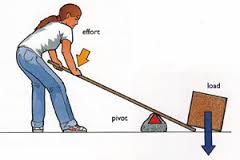
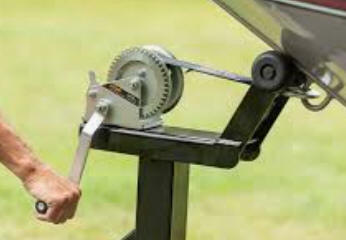
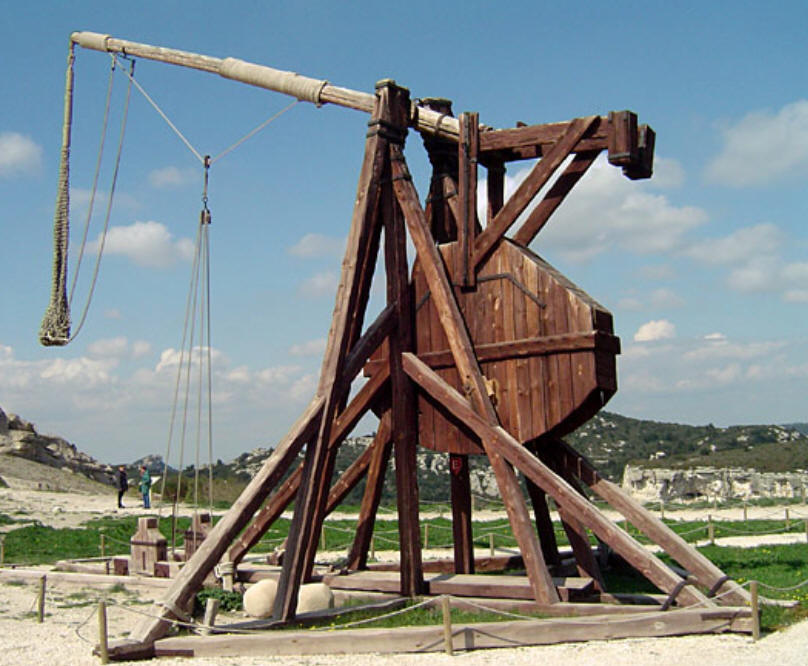
Tuesday, 12/19/25Warm Up: What is the advantage of using one of these pulley systems? How do they work?
Today:
- Quiz -- energy conservation and non-conservative work
- Pulley activity -- work two different ways
Until Next Class:
- None

 Class
35:
Tuesday, 12/16/25
Class
35:
Tuesday, 12/16/25Warm Up:
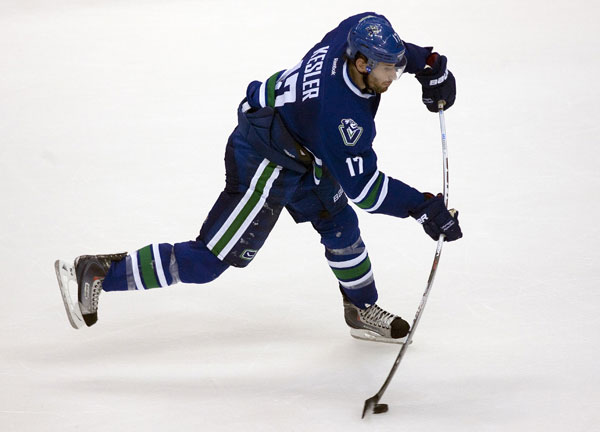
All of these "machines" work by changing the nature of work, but not the amount of work. W=Fd.
1. Identify all of the machines that change the user's work so that it looks like... W=Fd. Explain why anyone would want to change work in this way.
2. Identify all of the machines that change the user's work so that it looks like... W=Fd. Explain why anyone would want to change work in this way.
Today:
- Quiz -- graphing energy
- Continue Unit 4: Pages 6-7 Unit 4 Handout (PDF) Video on class playlist YouTube Playlist
- Pulley activity -- work two different ways
Until Next Class:
- Quiz like the problems on pages 6-7 of the handout YouTube Playlist
 Class
34:
Friday, 12/12/25
Class
34:
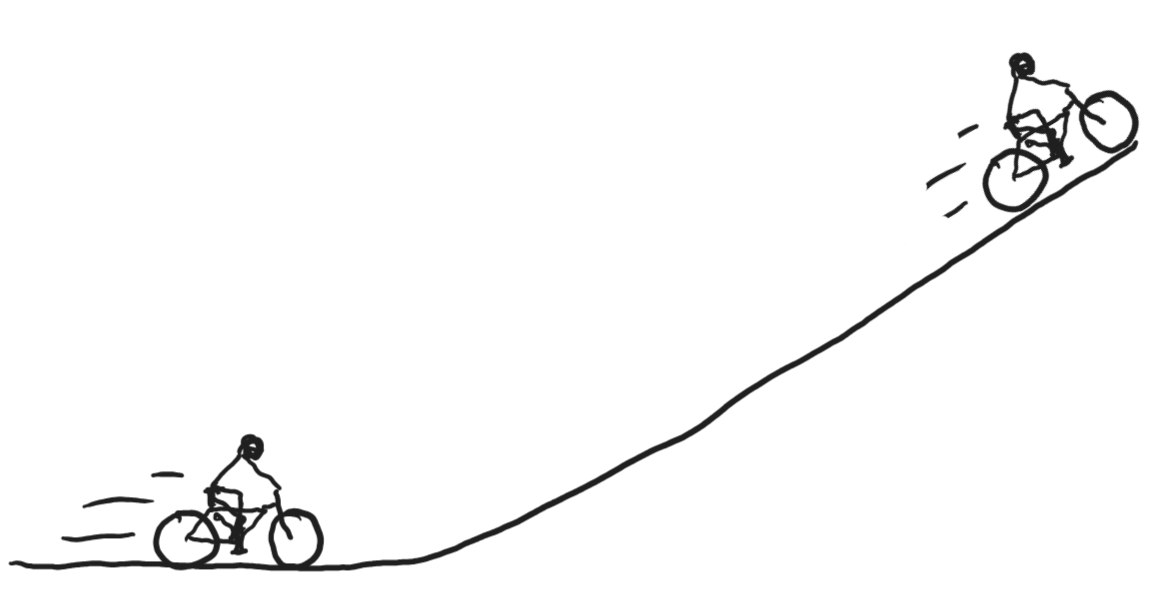
Friday, 12/12/25Warm Up: Sketch two sets of bar graphs representing the energy of a bicyclist riding up a hill and slowing down.
1
. In the first set, draw PE, KE, and OE for the before and after.2. In the second set, show only PE and KE, and make up the difference using Wnc (non-conservative work)
Today:
- Test retake
- Finish the lab
- Check Answers
- Practice for quiz next class
Until Next Class:
- Quiz next class -- like the warm-up, with and without numbers
 Class
33:
Wednesday, 12/10/25
Class
33:
Wednesday, 12/10/25Warm Up:
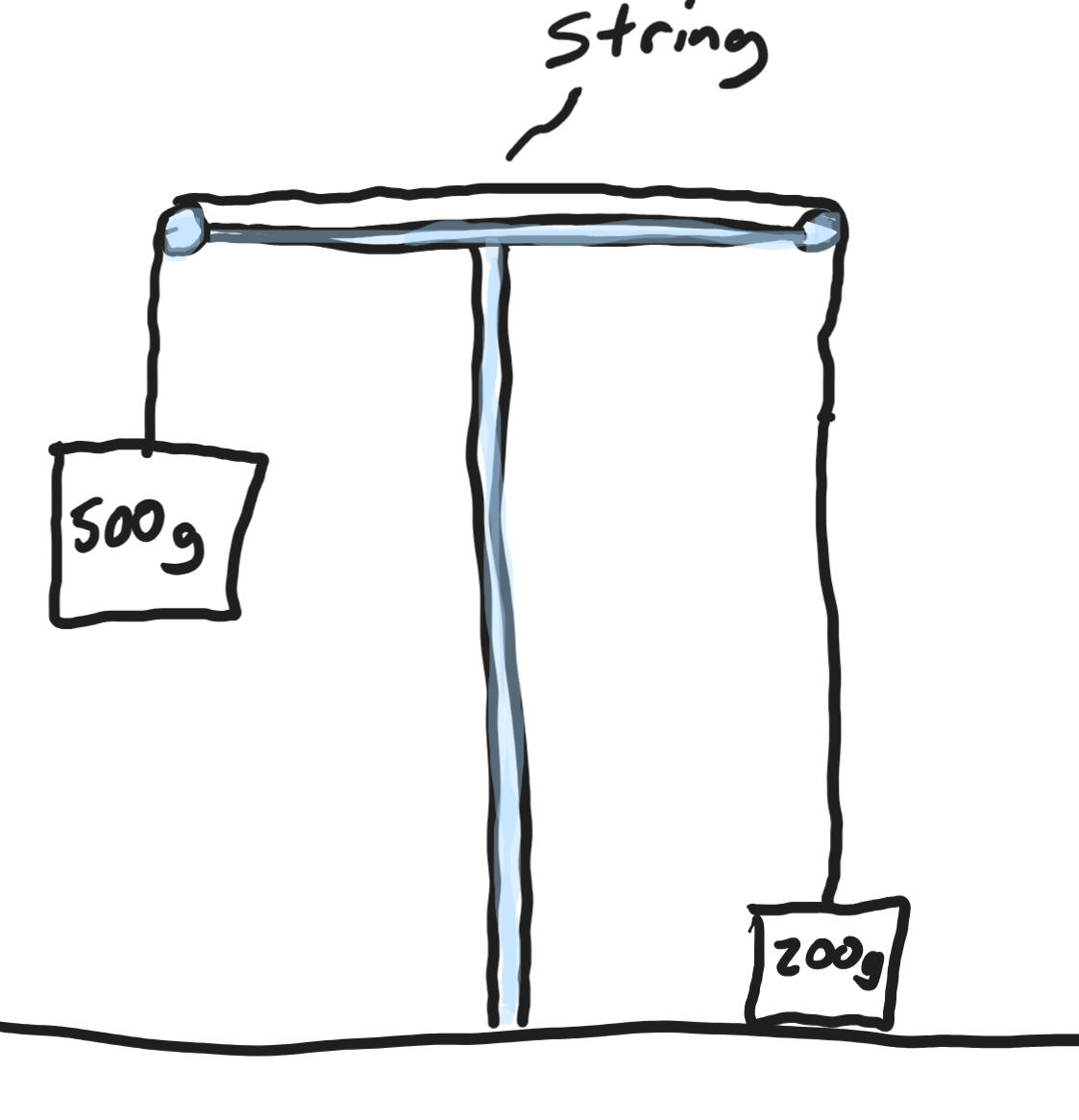
1. Let's sketch bar graphs of what happens to energy when the weights are released.
If we want to calculate the weights' actual potential and kinetic energies, we will need to measure height and time, and we will need to calculate velocity...
2. If the weights move a distance of 35cm, how many meters have they traveled?
3. If the weights move
that distance in1.2s, what is their speed at the end of that time
period? (use the two formulas on the right).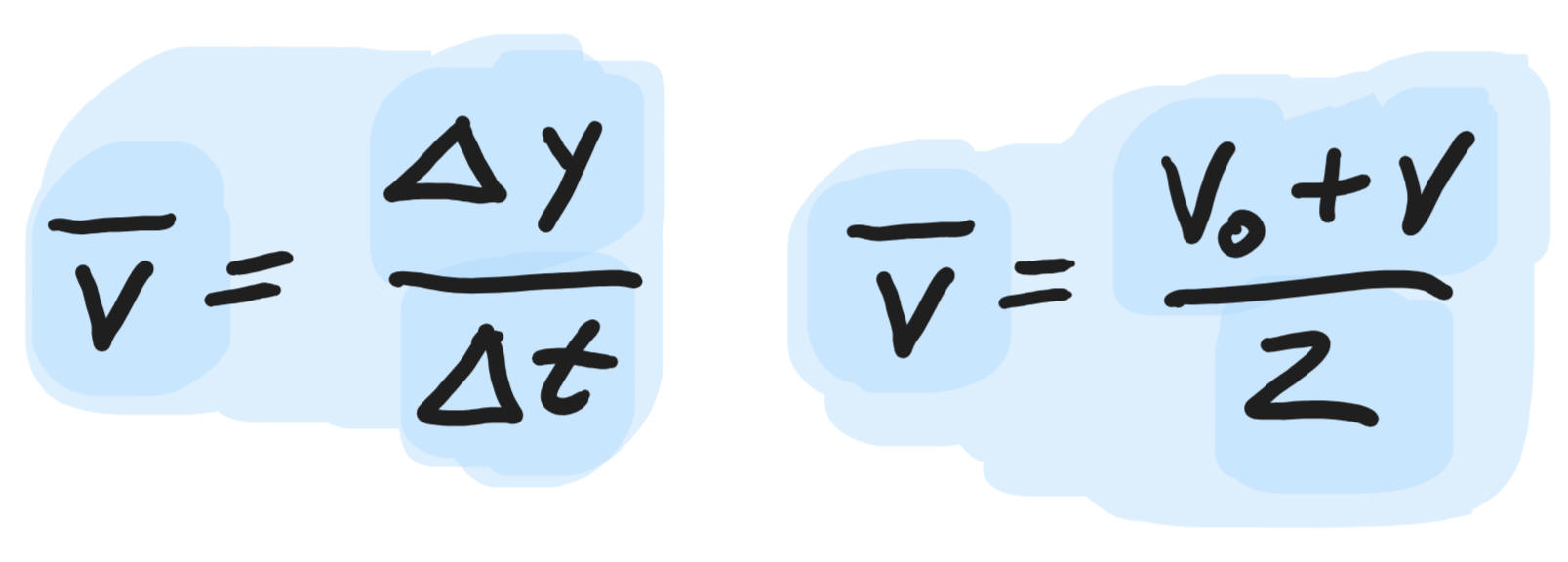
Today:
- Test retake is moved to next class
- Continue Unit 4: Energy and Work. Unit 4 Handout (PDF)
- Lab --
Analyze energy in a real system (it's in Google Classroom)
Until Next Class:
- Prepare for test/retake
 Class
32:
Monday, 12/8/25
Class
32:
Monday, 12/8/25Warm Up:
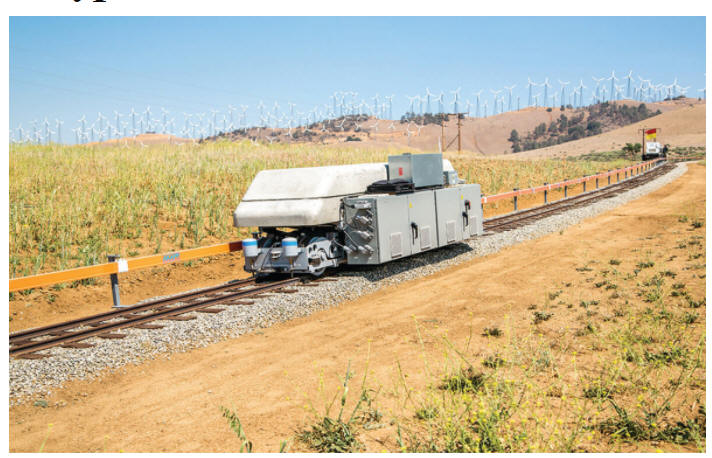
1. Can you guess what the "Sisyphus train" does? [Hint: it is an attempt to solve a big renewable energy problem.]
Today:
- Return and review test. Scores were generally low. Retake next class.
- 5+ Tardies -- call-backs
- Continue Unit 4: Energy and Work. Unit 4 Handout (PDF)
Until Next Class:
- If you want to improve your score, practice for the test retake. You can take it next class.
 Class
31:
Thursday, 12/4/25
Class
31:
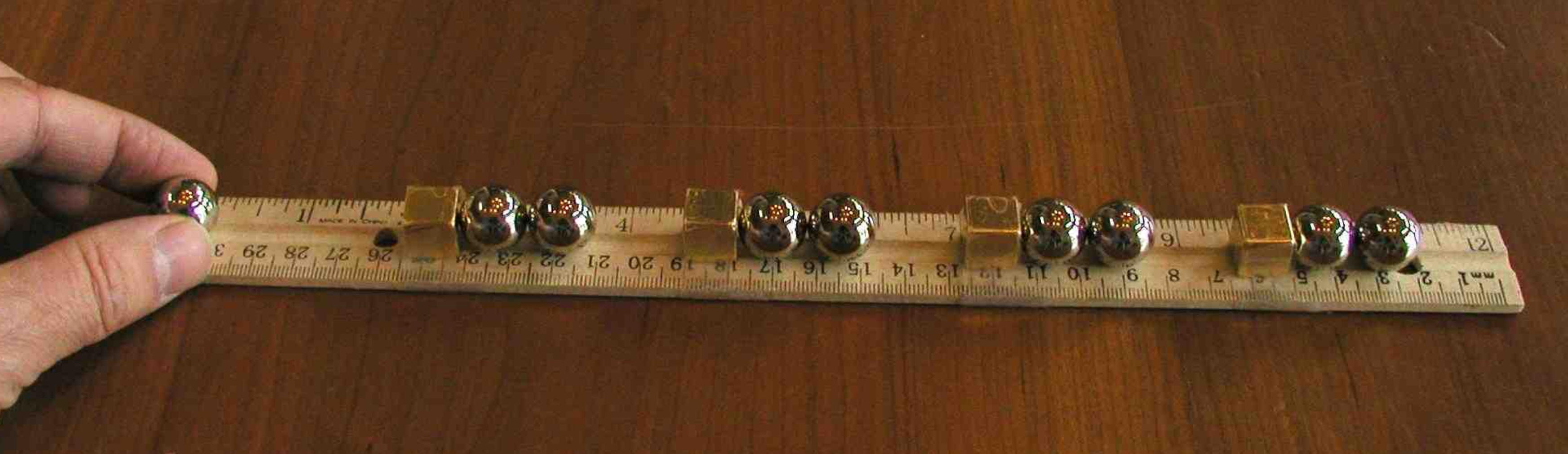
Thursday, 12/4/25Warm Up: What is this simulation supposed to demonstrate?
Today:
- Small Test -- Impulse and Momentum
- Begin Unit 4: Energy and Work. Unit 4 Handout (PDF)
- Notes Video -- See YouTube Video
Until Next Class:
- Have a great weekend!
 Class
30:
Tuesday, 12/2/25
Class
30:
Tuesday, 12/2/25Warm Up:
The photograph on the right shows a homemade "Gauss Gun." It's a little bit like a Newton's Cradle, except that it has magnets and no strings. Can you guess what it does and how it works?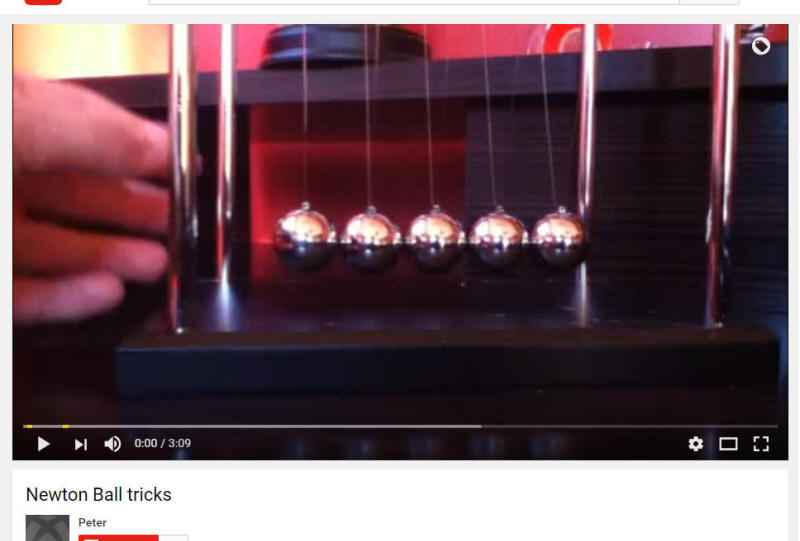
Today:
- Return Quizzes
- Practice Test -- Review for test next class
- (Unit 3 Packet -- PDF -- Answer Key)
- If there's time -- introduce Unit 4 -- Energy and Work. Discuss the plan?
Until Next Class:
- Test on Thursday -- same format as the "practice quiz"
 Class
29:
Friday, 11/21/25
Class
29:
Friday, 11/21/25Warm Up:
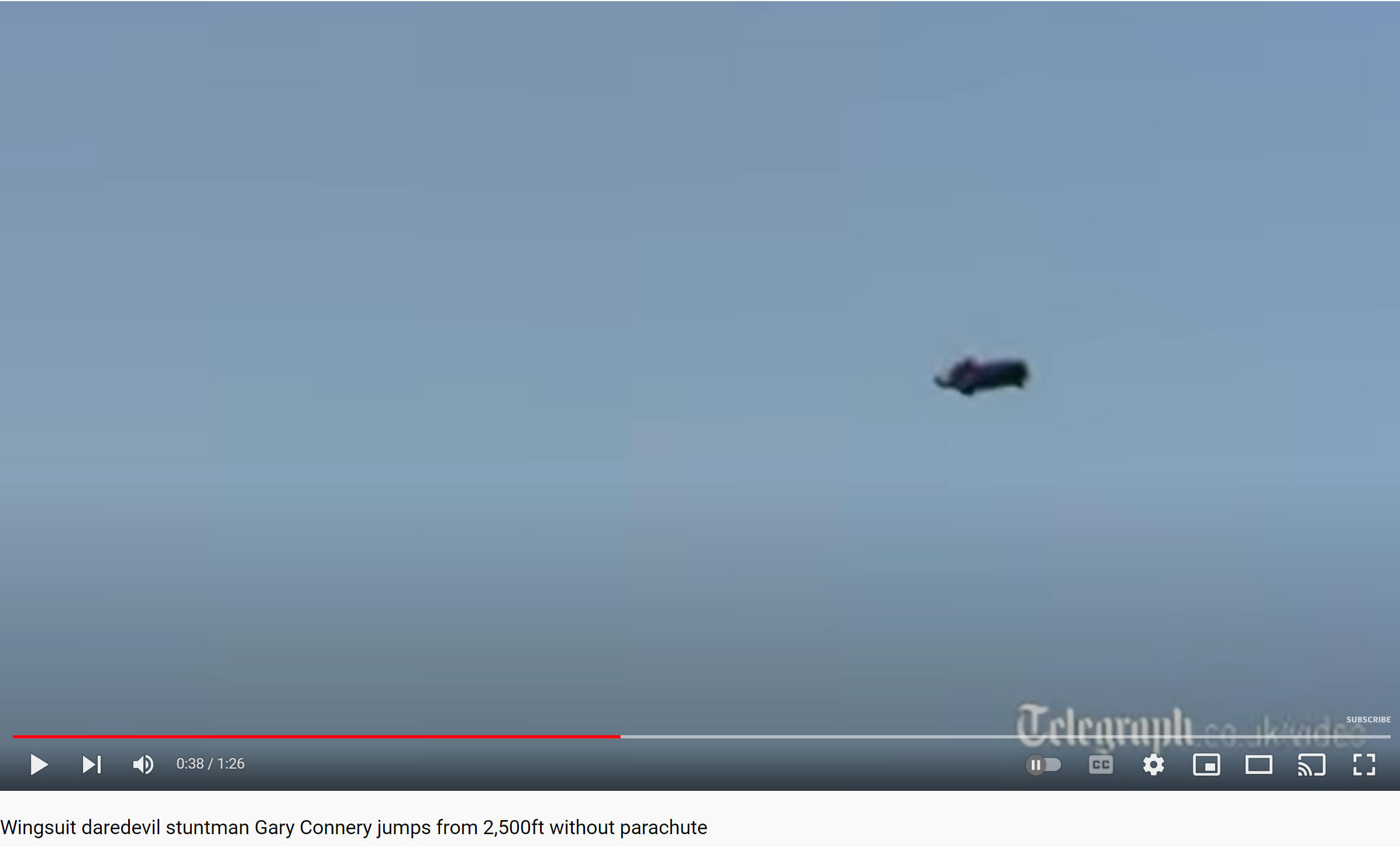
This picture shows a man who jumped from 2,500 feet with no parachute, but he is wearing a wing suit. Can you guess how he managed to land safely? Specifically, how can we explain the safe landing in terms of impulse (Ft)? Watch this video for the answer!
Today:
- Prepare for quiz. Take quiz.
- Measure jump height and soft landings
- (Unit 3 Packet -- PDF -- Answer Key)
Until Next Class:
- NA
Class
28:
Wednesday, 11/19/25Warm Up:
What can a Newton's Cradle demonstrate?
Today:
- Finish the Impulse and momentum lab PDF
- Prepare for Friday's quiz over the impulse formula
- (Unit 3 Packet -- PDF -- Answer Key)
Until Next Class:
- Quiz over impulse and momentum
 Class
27:
Monday, 11/17/25
Class
27:
Monday, 11/17/25Warm Up: Suppose I place some foam on my table top, and then I shoot it with the two darts in the picture, using the same Nerf ® gun. Compare the effects of the two darts impact on the motion of the foam.
Today:
- Return quizzes
- Impulse and momentum lab PDF
- (Unit 3 Packet -- PDF -- Answer Key)
Until Next Class:
- NA
 Class
26:
Thursday, 11/13/25
Class
26:
Thursday, 11/13/25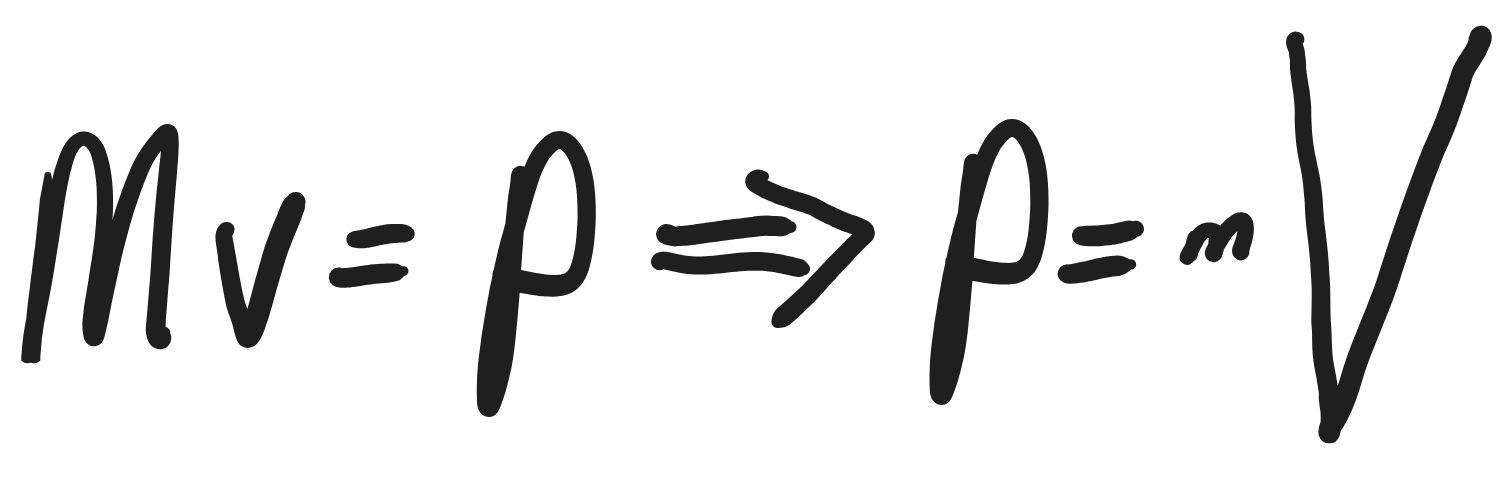
Warm Up:
1. What do the letters p, m, and v stand for in the equations on the right?
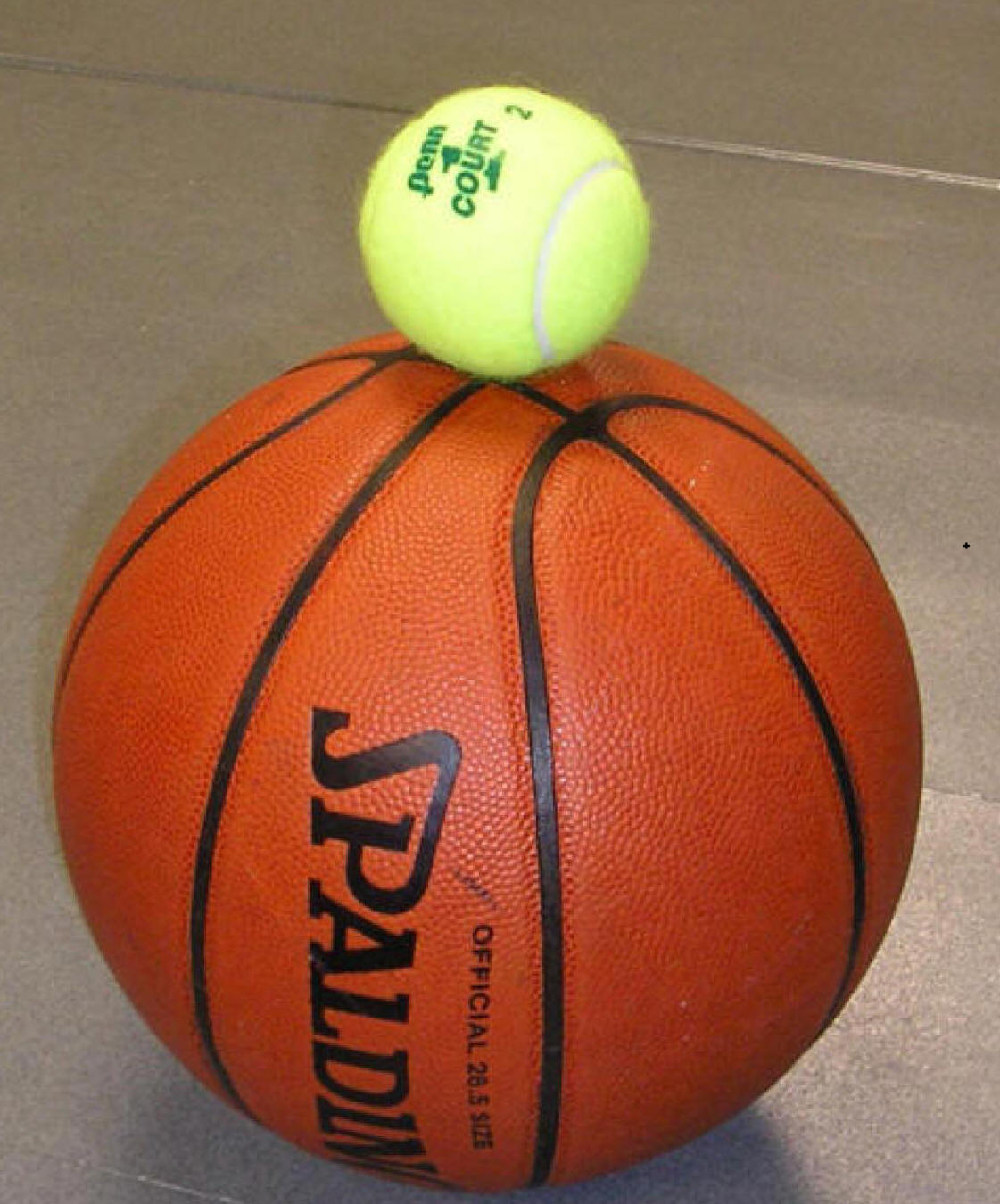
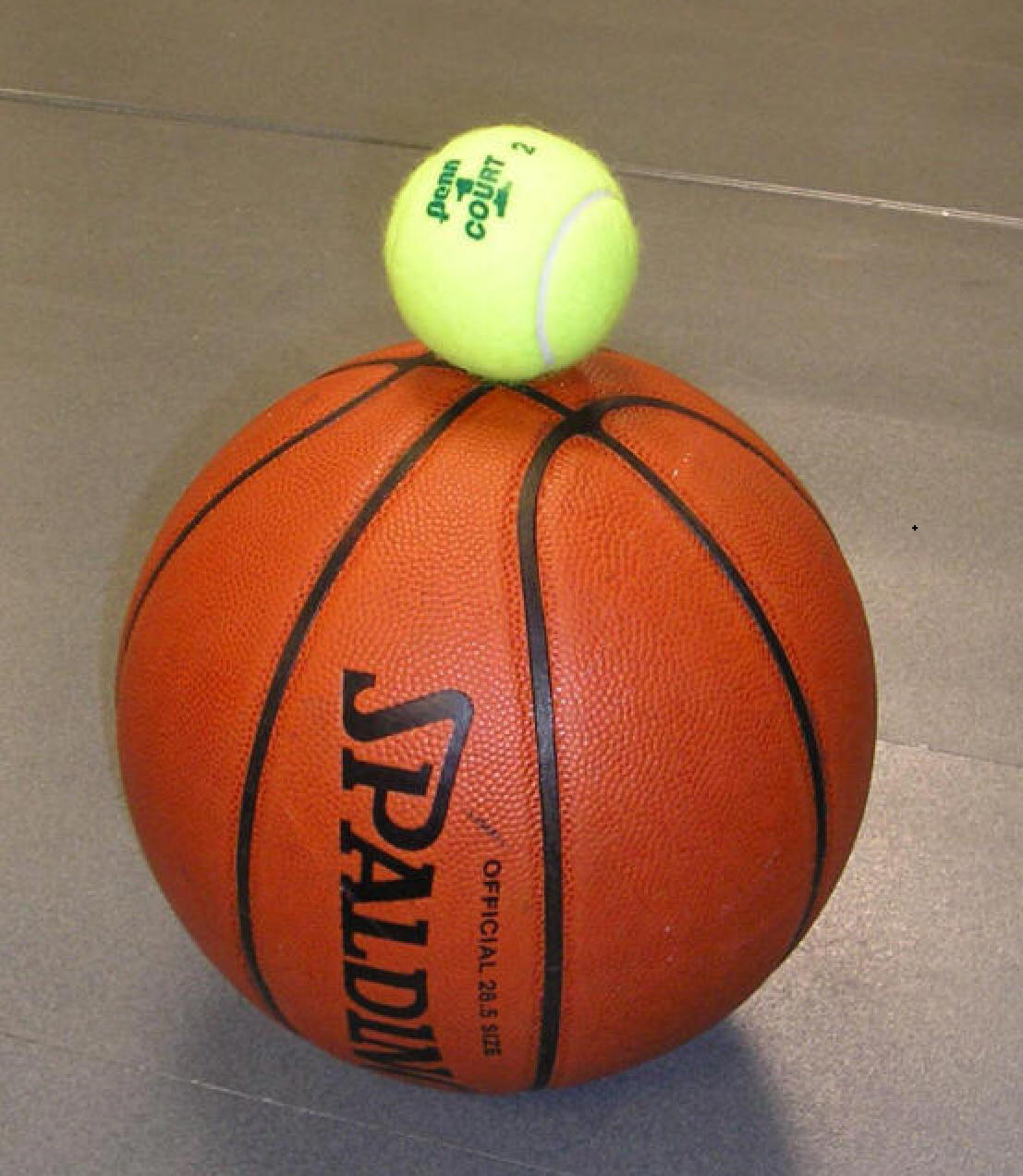
2. How do the equations explain what happens when a tennis ball is bounced on top of a basketball?
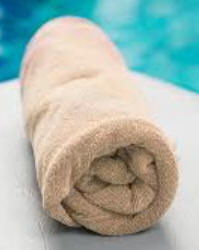
3. Sometimes people turn towels into whips. How can we apply the basketball/tennisball concept to make a better towel whip? (not to be used on humans, of course)
Today: Quiz and Intro to Impulse (which gets mentioned a lot relating to collisions)
- New caddy numbers
- Short practice before quiz. The quiz is a little different than the practice problems from last class.
- Quiz -- Conservation of Momentum. The triangle version of the momentum formula will not be provided. Does anyone need a review of how to make the triangle?
-
Impulse Notes
- (Unit 3 Packet -- PDF -- Answer Key)
- Impulse notes on page 2-3
- VIDEO from past year's class
Until Next Class:
- None
 Class
25:
Tuesday, 11/11/25
Class
25:
Tuesday, 11/11/25Warm Up:
1. What will happen if I hold a tennis ball on top of a basketball and drop them to the floor together?
2. Why does this happen? How is this related to supernovae?
Today:
- Return tests -- go over answers and make a VIDEO. Retakes available in FLEX beginning on Thursday.
-
Begin Momentum & Impulse
- (Unit 3 Packet -- PDF -- Answer Key)
- Notes on page 1-2, plus some conservation of momentum practice problems.
- VIDEO from past year's class
Until Next Class:
- Prepare for Quiz like the momentum practice problems on pages 3-4
 Class
24:
Friday, 11/7/25
Class
24:
Friday, 11/7/25Warm Up:
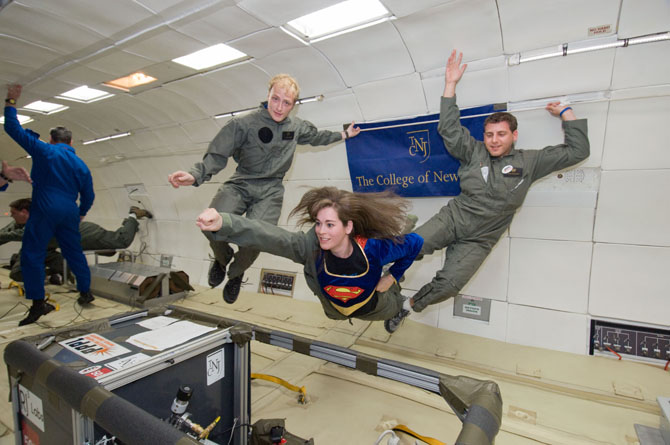
How does NASA simulate zero g conditions? Are the people in the video really weightless? Are astronauts in a space station weightless?
Today:
- A little more review -- I forgot to go over a bathroom scale problem.
- Test
-
If there's time... Begin Momentum & Impulse
- (Unit 3 Packet -- PDF -- Answer Key)
- Notes on page 1-2, plus some conservation of momentum practice problems.
- VIDEO from past class
Until Next Class:
- None
 Class
23: Wednesday, 11/5/25
Class
23: Wednesday, 11/5/25Warm Up:
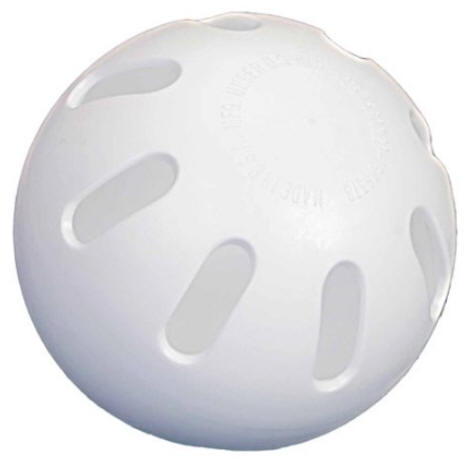
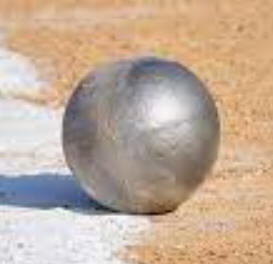
1. Which can you throw with more force, a Wiffle Ball® (0.045kg), a baseball (0.145kg), or a shot put (5.45kg)? Or is there no difference? Explain your thinking. Some calculations -- don't peek before thinking.
2. What limits the amount of force that you can apply when you throw an object?
Interesting Link: article about the fastest pitch ever thrown
Today:
- Quiz -- return quizzes
-
Forces test next class.
- Units will be on the test -- Google Quiz practice
Until Next Class:
- Test next class
 Class
22: Monday, 11/3/25
Class
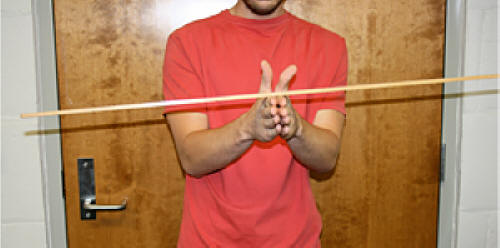
22: Monday, 11/3/25Warm Up: One way to find the center of mass (a.k.a. balance point) of a stick is to support it with two hands and then slowly move those two hands together until they meet under the stick's center of mass. Why does this method work?
Today:
- Unit 2 handout (PDF) Answers
- Notes: Friction and Friction Problems (p. 10-11)
- Real-life problem -- find the force of friction acting on a sliding object. If you don't still have your data from sliding an object 3 classes ago, we will need to collect new data.
- Forces test is coming soon.
Until Next Class:
- Quiz like the friction problems
 Class
21:
Thursday, 10/30/25
Class
21:
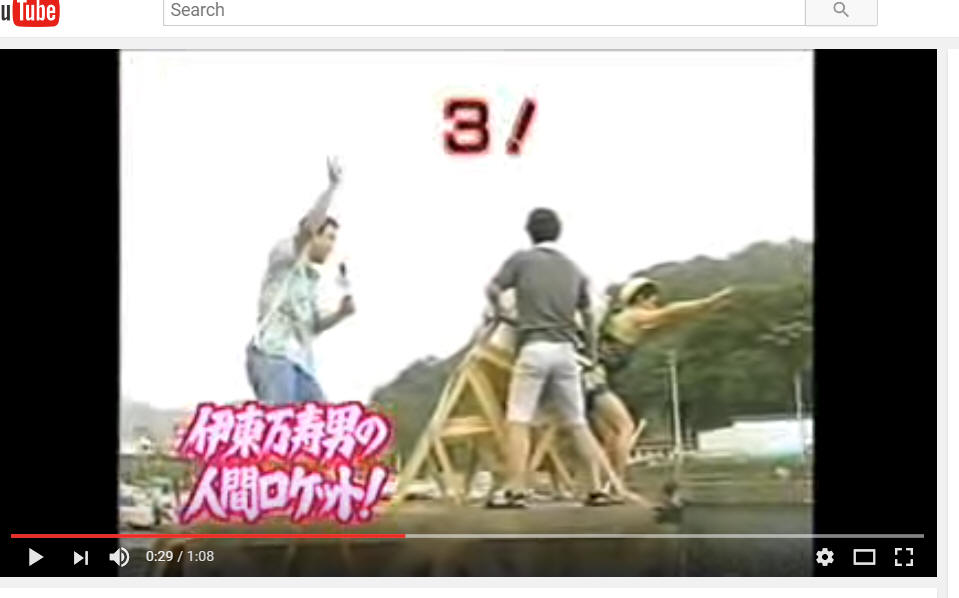
Thursday, 10/30/25Warm Up: Is this for real? Could we launch a student this high with water rockets? spreadsheet
Today:
- Quiz retake -- optional
- Rocket analysis
- What is the force of a water rocket's thrust?
- How high did they go?
- What were their drag coefficients (approproximately)
- Find out how high we could launch a student
Until Next Class:
- None
 Class
20:
Tuesday, 10/28/25
Class
20:
Tuesday, 10/28/25Warm Up: This 50kg rower has an acceleration of -1m/s2. She is pulling against the oars with a force of 100N. Draw and calculate all of the forces acting on the rower.
Today:
- Quiz
- Launch rockets. Collect data.
- Record your rocket's dry mass
- Add water to your rocket -- record the amount of water that you added
- Dress warm
- Launch and record video data -- we will determine forces next class
- Disassemble Rockets. Return reusable parts. Recycle plastic. Throw duct tape in the trash :-(
Until Next Class:
- None
 Class
19:
Wednesday, 10/22/25
Class
19:
Wednesday, 10/22/25Warm Up:
1. Why don't clouds fall?
2. Assuming that an object's density and shape are held constant, what changes faster as the size of the object changes -- cross-sectional area or mass?
3. People have recently been celebrating the release of prisoners by firing guns into the air. Is this sort of gunfire safe, as long as you shoot straight up?
Today:
- Quiz retakes?
- Finish terminal velocity tables
- Unit 2 handout (PDF) Answers
- Practice problems -- friction and elevators?
Until Next Class:
- Quiz next class like the terminal velocity table from the notes.
 Class
18:
Monday, 10/20/25
Class
18:
Monday, 10/20/25Warm Up:
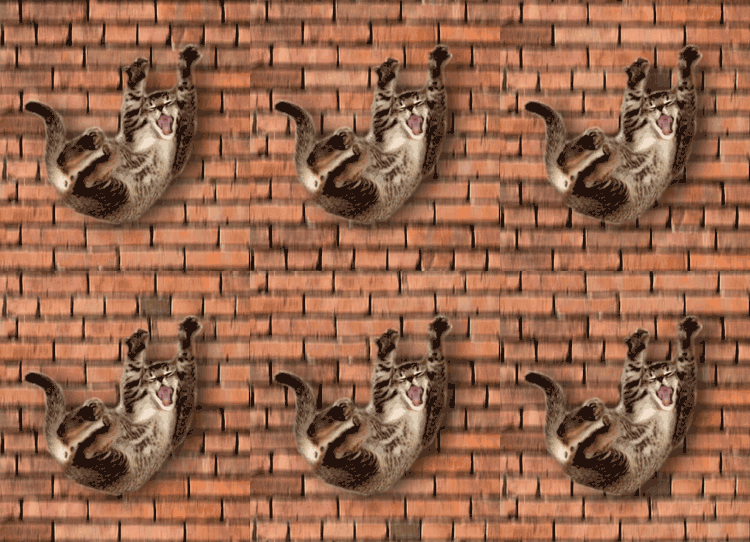
According to this article, emergency clinic records of 132 cats that jumped from windows of buildings showed a 90% survival rate. The average drop was 5.5 floors.
1. What's going on?
2. What's the rule for deciding whether to use "less" or "fewer?" Which applies here?
3. When does a falling cat experience zero net force?
4. When is a falling cat a "free-falling" cat?
Today:
- Return quizzes
- Finish making rockets
- Notes on terminal velocity
- Unit 2 handout (PDF) Answers
Until Next Class:
- Optional -- Quiz retake on Wednesday
 Class 17:
Thursday, 10/16/25
Class 17:
Thursday, 10/16/25Warm Up:
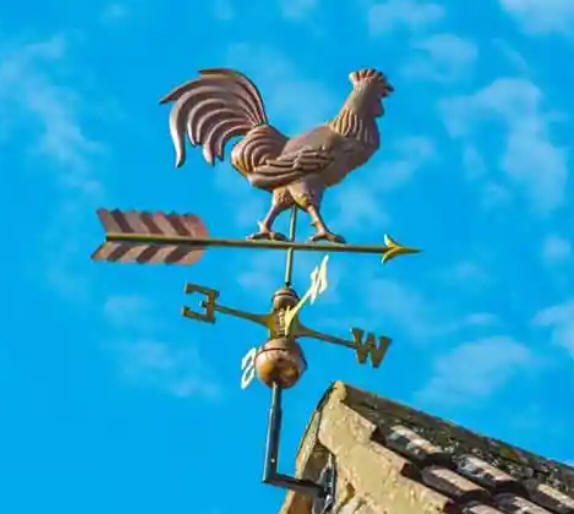
1. What does a weather vane do? How does it work?
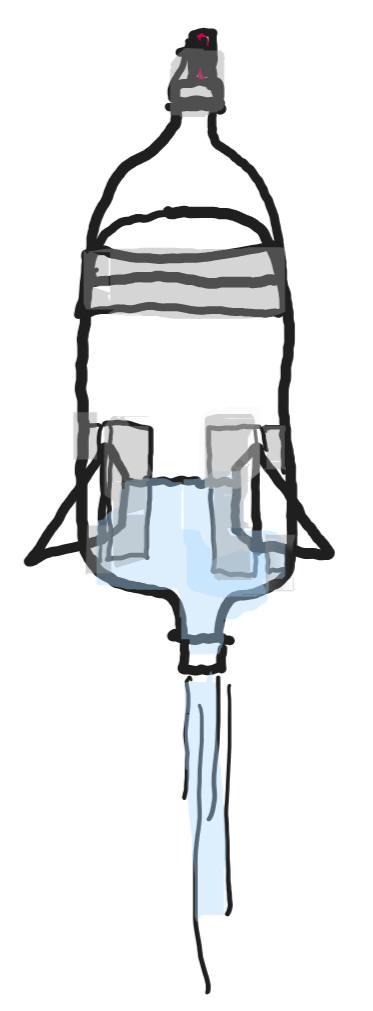
2. How does a water rocket work? Video of a Water Rocket Launch
Today:
- Quiz -- Video of quiz solutions and explanations
- Build Rockets?
- Unit 2 handout (PDF) Answers
Until Next Class:
- Optional -- Quiz retake on Wednesday
- Have a great weekend!
 Class 16:
Tuesday, 10/14/25
Class 16:
Tuesday, 10/14/25Warm Up:
We have a very precise digital scale.1
. When you step onto a scale, what do the numbers tell you?2. Would the scale work in outer space? Why or why not?
3. Is there anything interesting that we can do with this scale?
Today:
- Finish going over the Newton Sled Answers
- Newton's 2nd law problems Video from class
- Prepare for quiz next class
- Unit 2 handout (PDF) Answers
Until Next Class:
- Quiz next class -- like #1-6 on pages 16-17 of the handout Answers Video from class
 Class 15:
Friday, 10/10/25
Class 15:
Friday, 10/10/25Warm Up: According to Newton's 3rd Law, every force has an equal and opposite force. So how do you win a game of tug-of-war?
Today:
- Decide whether or not to drop the quizzes.
- Newton's 3rd Law Notes
- Finish the Newton Sled Activity
- Unit 2 handout (PDF) Answers
- If there's time... Newton's 2nd law problems -- maybe experiment with the force plate
Until Next Class:
- None
 Class 14:
Wednesday, 10/8/25
Class 14:
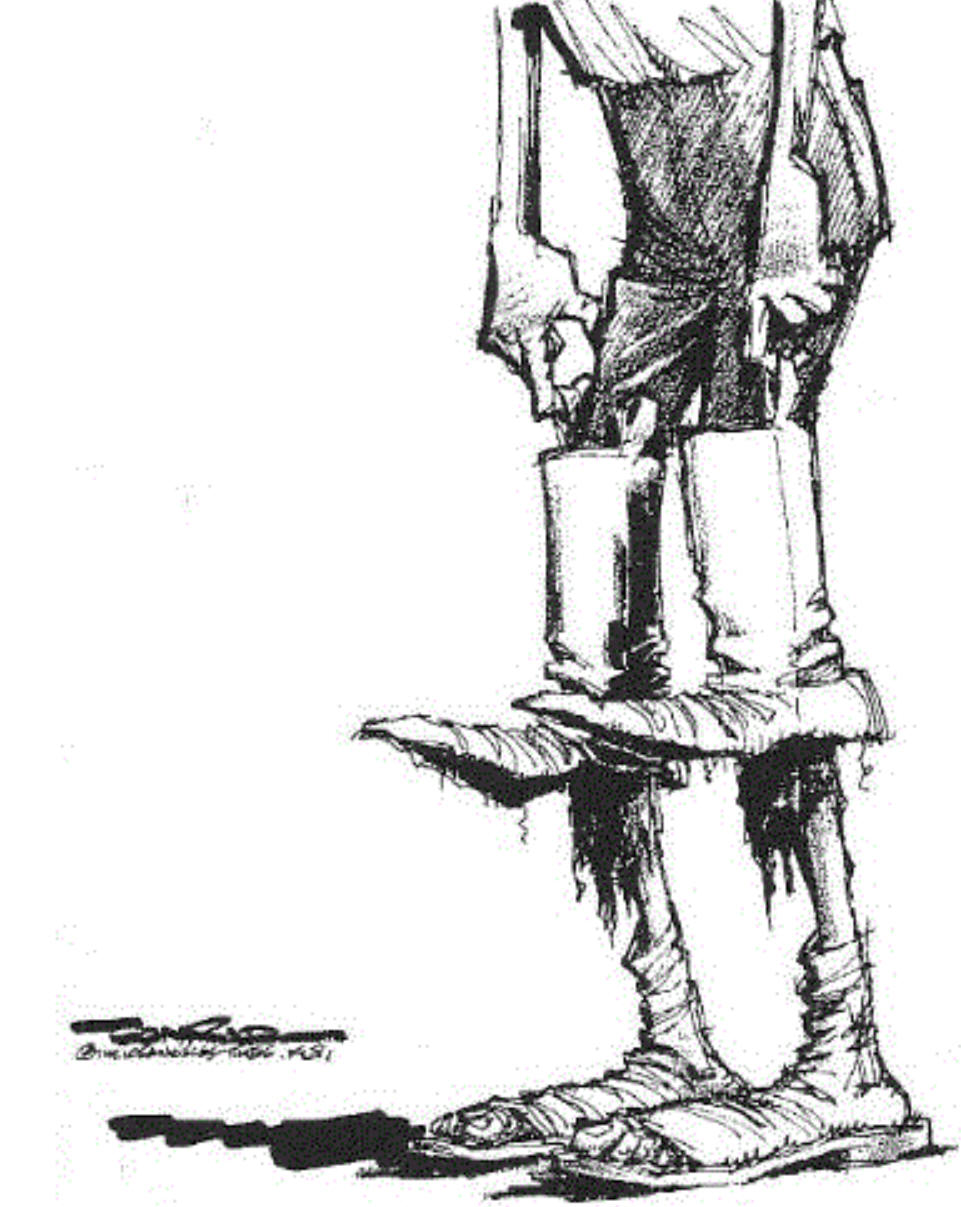
Wednesday, 10/8/25Warm Up: Is it literally possible to "pull yourself up by your own bootstraps?" Put another way, can you pick yourself up? Explain.
Today:
- Retake -- test page 4 -- kinematics problems
- Continue Unit 2: Forces Unit 2 handout (PDF) Answers. Begin at Newton's 3rd Law.
- Start the Newton Sled Activity
Until Next Class:
- None
 Class 13:
Monday, 10/6/25
Class 13:
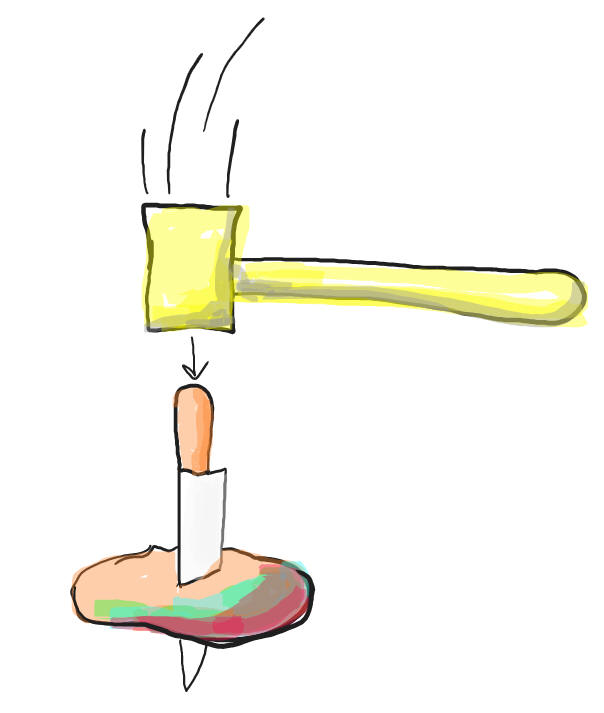
Monday, 10/6/25Warm Up: What will happen if I poke a knife through a potato, hold both objects in the air with the knife pointing downward, and then hammer the butt of the knife into the potato? Why? What if it's an apple, because I didn't have potatoes? What can I use if I forgot any fruit or vegetables?
Today:
-
Return Tests
- go over answers and check for grading errors
- Do some more practice problems like page 4 -- unless your score was 13.5 or better on page 4, there is an required retake next class. Make a Video.
- Videos to help you prepare for retaking the test are in the class YouTube playlist. You can retake pages 1,2 or 3 during FLEX or before school, beginning next week.
- Let's wait to look at dropping quiz grades until after next class.
- Continue Unit 2: Forces Unit 2 handout (PDF) Answers. Begin at Newton's 3rd Law.
Until Next Class:
- Page 4 retake next class. Practice. Solve the test questions while covering your work. Try the practice questions from class -- hopefully I made a video.
 Class 13:
Wednesday, 10/1/25
Class 13:
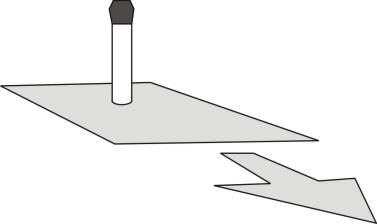
Wednesday, 10/1/25Warm Up: It is possible to remove a sheet paper from under a dry erase pen without touching or tipping the pen. How can one do this without tipping the pen? Why does the pen usually fall?
Today:
- Test
- Begin Unit 2: Forces Unit 2 handout (PDF) Answers -- we stopped just before Newton's 3rd Law.
Until Next Class:
- Have a great weekend!
 Class 12:
Monday, 9/29/25
Class 12:
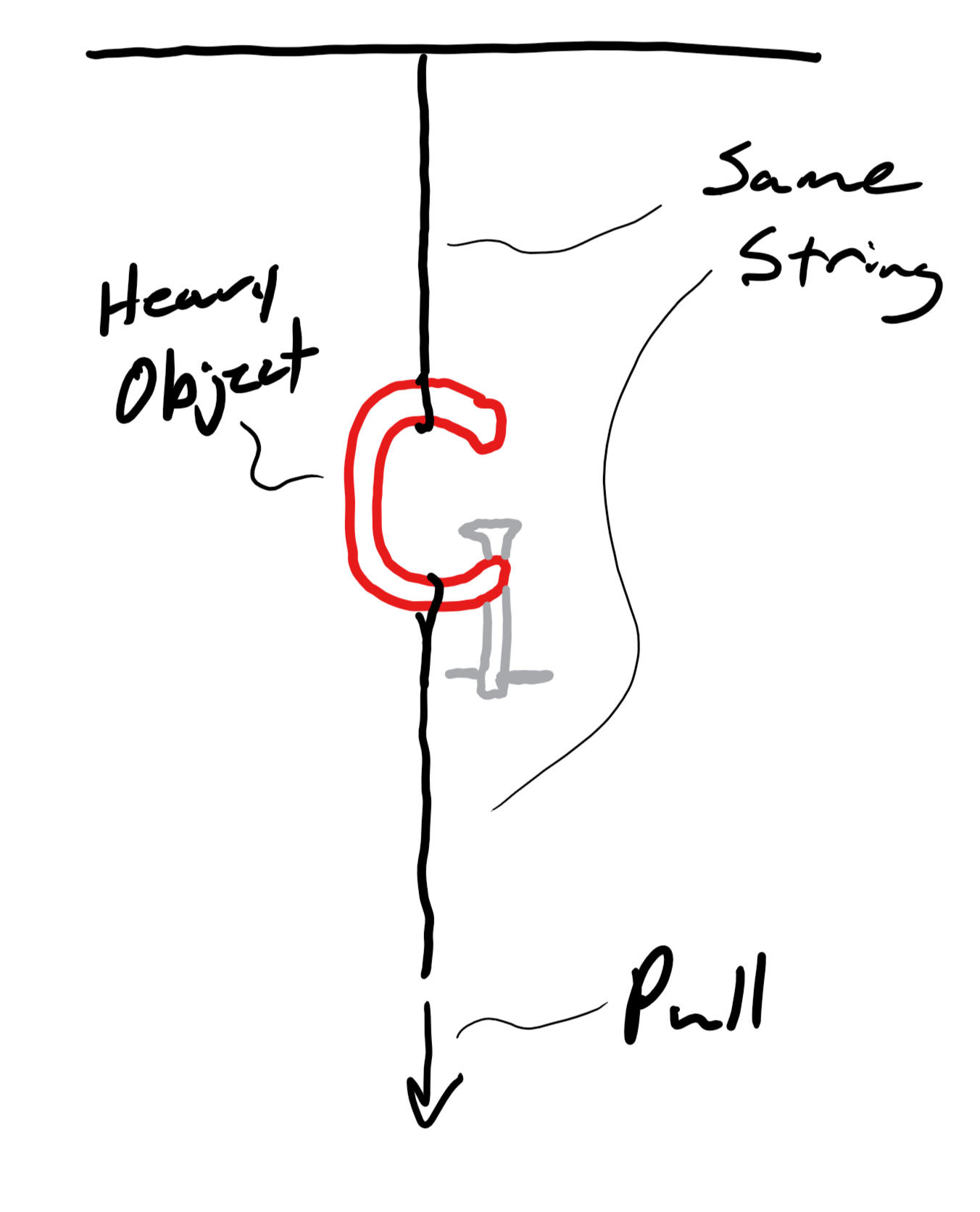
Monday, 9/29/25Warm Up: There is a heavy object suspended from the ceiling by a string. Another segment of the same string is hanging downward from the object. I am going to pull on the bottom string until one of the two strings breaks. Which string is going to break first? Why?
Today:
- Quiz -- Using Motion Formulas -- the video is in the class video playlist
- Final practice -- what's on the test. See the review at the back of the handout... Unit 1 (Motion) Handout (PDF)
- Videos from the test review are in the class video playlist
- Begin Unit 2: Forces Unit 2 handout (PDF) Answers
Until Next Class:
- Study -- Unit 1 (Motion) Test on Wednesday
 Class 11:
Thursday, 9/25/25
Class 11:
Thursday, 9/25/25Warm Up:
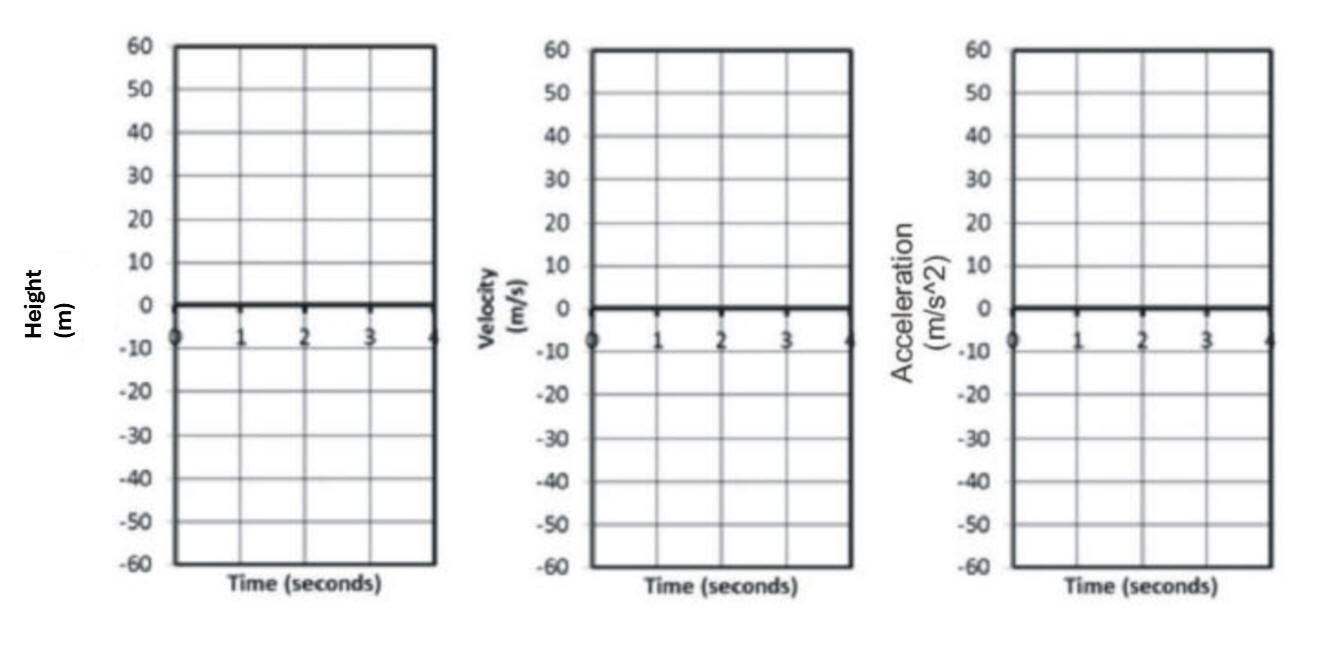
Consider the case of this ball. At t = 0s, the ball is flying directly upward at a height of 0m, with a speed of 20m/s. Sketch graphs of the ball's position, velocity, and acceleration (vs. time) over the next 4 seconds.
Let's assume that there is no air resistance and that g = 10m/s2.
Today:
- Quiz retake?
- Return Quizzes
- Practice with problems -- using kinematics formulas -- get a video part 1 part 2
- Make a formula list?
- Test will be next Wednesday. -- not Monday.
- There will be a quiz on Monday over problems with motion formulas -- and possibly other things that you want to work on.
Until Next Class:
- Study -- Quiz on Monday
 Class
10:
Tuesday, 9/23/25
Class
10:
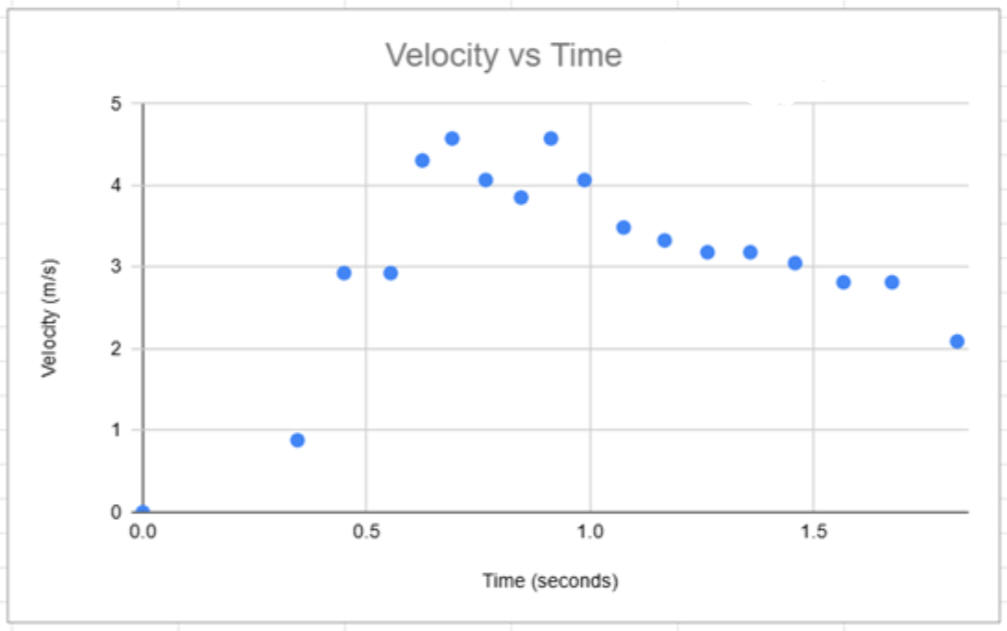
Tuesday, 9/23/25Warm Up: Let's find the g-forces that it experienced as it got faster than then as it slowed down.
[This is one of your graphs. Does anyone recognize it?]1
. How many g's is safe for humans?2. Estimate the maximum positive slope, in m/s2 (max positive acceleration)
3. Estimate the maximum negative slope, in m/s2.
4. Convert these accelerations to g's by dividing them by 1g (9.8m/s2)
Today:
- Quiz -- Video going over quiz
- Analyze the car graphs that we made last class
- Start the review and practice problems on p. 11 -- Part 1 Part 2
Until Next Class:
- Review anything that you found challenging. We will review next class, and we will probably have the first test next Monday.
 Class
9: Friday, 9/19/25
Class
9: Friday, 9/19/25Warm Up:
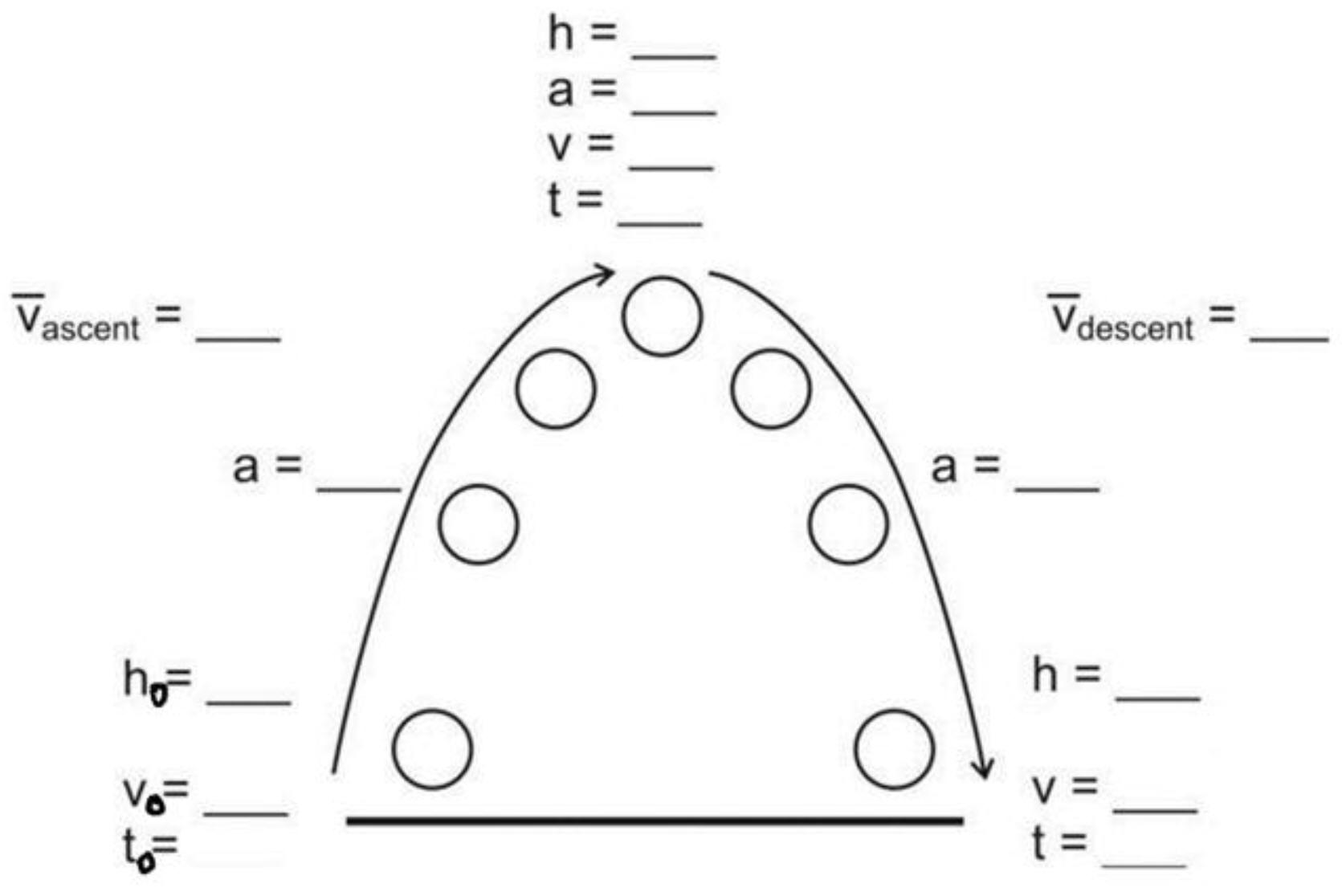
Let's talk about "free-fall" so we can discuss g's of spool car acceleration later on. 1g = 9.8m/s2, but for this exercise, let's round it to 10m/s2.Our task is to fill in all of the blanks on the right for a ball that is launched directly upward at a velocity of 40m/s.
Today:
- Practice Quiz -- Calculating Acceleration from a Position vs Time Graph (PDF) Video from class
- Create position and acceleration graphs of spool cars from videos. Compare their accelerations to gravity.
- We're done with new stuff! We can have a test soon (and move on to forces)! Start the review and practice problems on p. 11-12
Until Next Class:
- Next class: quiz like today's practice quiz
 Class
8: Wednesday, 9/17/25
Class
8: Wednesday, 9/17/25Warm Up:
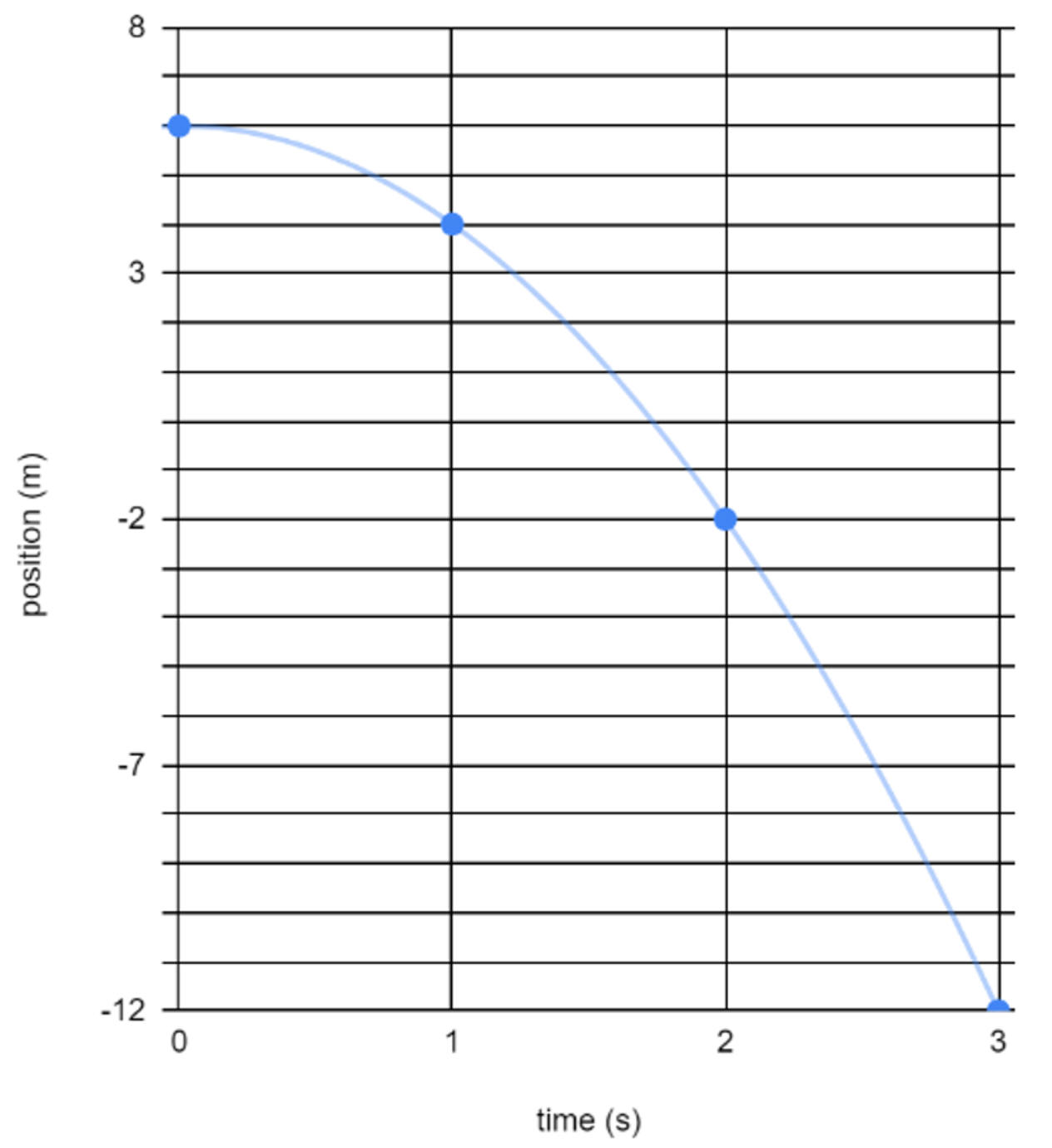
We're going to use this position vs time graph to find acceleration of the moving object.1
. What is the object's displacement between 0s and 1s?2. What is the object's velocity between 0s and 1s?
3. What is the object's displacement between 1s and 2s?
4. What is the object's velocity between 1s and 2s?
5. What is the object's displacement between 2s and 3s?
6. What is the object's velocity between 2s and 3s?
7. What is the acceleration of the object?
Today:
- Handout Key For Pages 1-8 (what we've done up until today)
- Today's Goals:
- Finish crashing and videoing the cars
- Notes: Find acceleration using graphs of position vs time -- Handout p. 9 Video from class
- Find spool car acceleration and deceleration (during a crash) using video analysis and a velocity graph. Here are the videos from last class. We need a few more.
Until Next Class:
- Practice quiz next class -- finding acceleration from a position graph (like p. 9) and a velocity graph (like the spool car graphs)
Warm Up: Complete the warm-up -- motion combinations practice in Google Classroom.
Today:
- Quiz. Video going over quiz solutions.
- Today's Goal: Practice using video analysis to create graphs of position and velocity, vs time.
- Get a video of your spool car crashing into the wall with the highest possible force. We will find both the acceleration and deceleration.
Until Next Class:
- If you want to retake today's quiz, ask for it before class starts on Wednesday.
 Class
6:
Thursday, 9/11/25
Class
6:
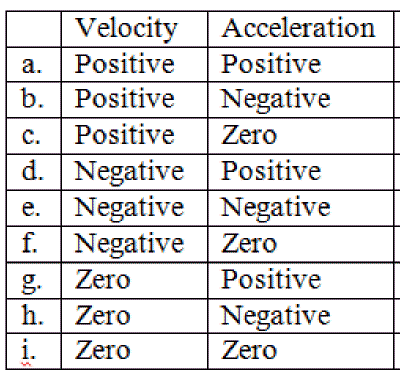
Thursday, 9/11/25Warm Up: I want to demontrate the types of motion on the right, using a cart on a track. I can tilt the track using books. How can I do each of these? Which ones are hardest? Let's assume for this activity that left is negative and right is positive.
Today:
- Finish notes on pages 7-8
- Unit 1 (Motion) Handout (PDF)
- Short Practice Quiz:
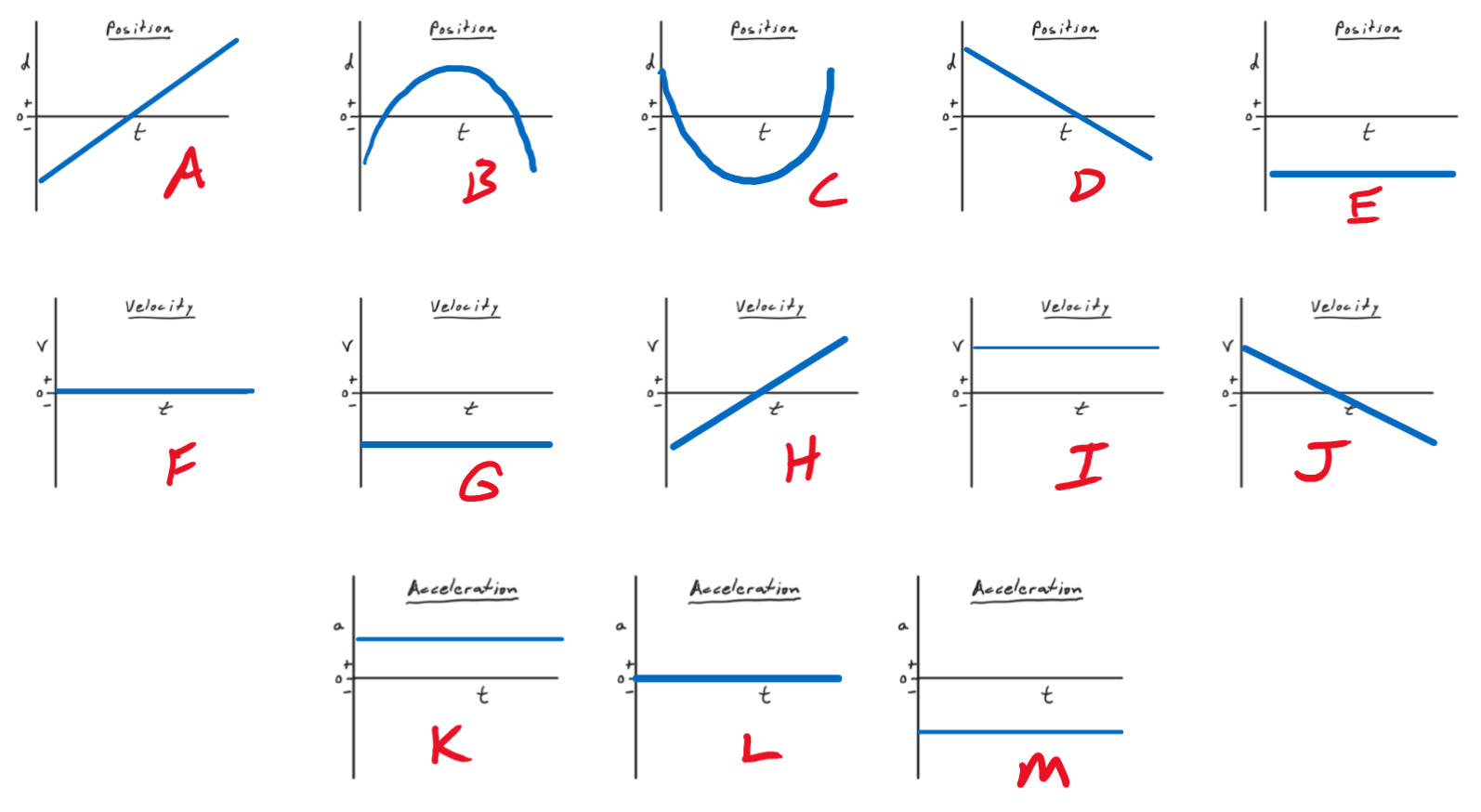
- Part 1: Group these graphs into 5 groups
of 3 that each represent the same motion.
- Part 2:
- Calculate the acceleration of a car whose velocity changes from 80m/s to 60m/s in a time of 4 seconds.
- Part 1: Group these graphs into 5 groups
of 3 that each represent the same motion.
Until Next Class:
- Quiz next class -- like the practice quiz
.JPG) Class 5:
Tuesday, 9/9/25
Class 5:
Tuesday, 9/9/25Warm Up:
The graph on the right shows the positions at different times for seven different people, relative to a motion detector at the 0m mark. Which person (people) was (were)...- moving at a constant speed
- moving toward the sensor
- not moving at all
- accelerating
- decelerating
- accelerating the fastest
- moving at the fastest constant speed
Today:
- Return and review quizzes.
- Notes: p.5 through the top of p.6 (acceleration) Video
- Quiz Retake for anyone who wants it -- Distance, Displacement, Change in Time, Speed, Average Velocity (both formulas) -- or short break
- Notes: p. 6, and 8 (acceleration and motion graphs) Video
- Can we get to p. 9??
- Today's New Learning Targets are in
cyan
VM.x - I can draw and interpret diagrams to represent the motion of an object moving with a constant velocity
CVM.x - I can solve constant velocity problems
CAM.x - I can draw and interpret diagrams to represent the motion of an object moving with changing velocity
CAM.x - I can solve constant acceleration problems.
CAM.x - I can solve kinematic equations
Until Next Class:
- Practice Quiz next class -- similar to handout page 6 and 8.
- Next class -- probably measuring spool car accelerations
- Class after next -- 2nd quiz
 Class
4:
Friday, 9/5/25
Class
4:
Friday, 9/5/25Warm Up:
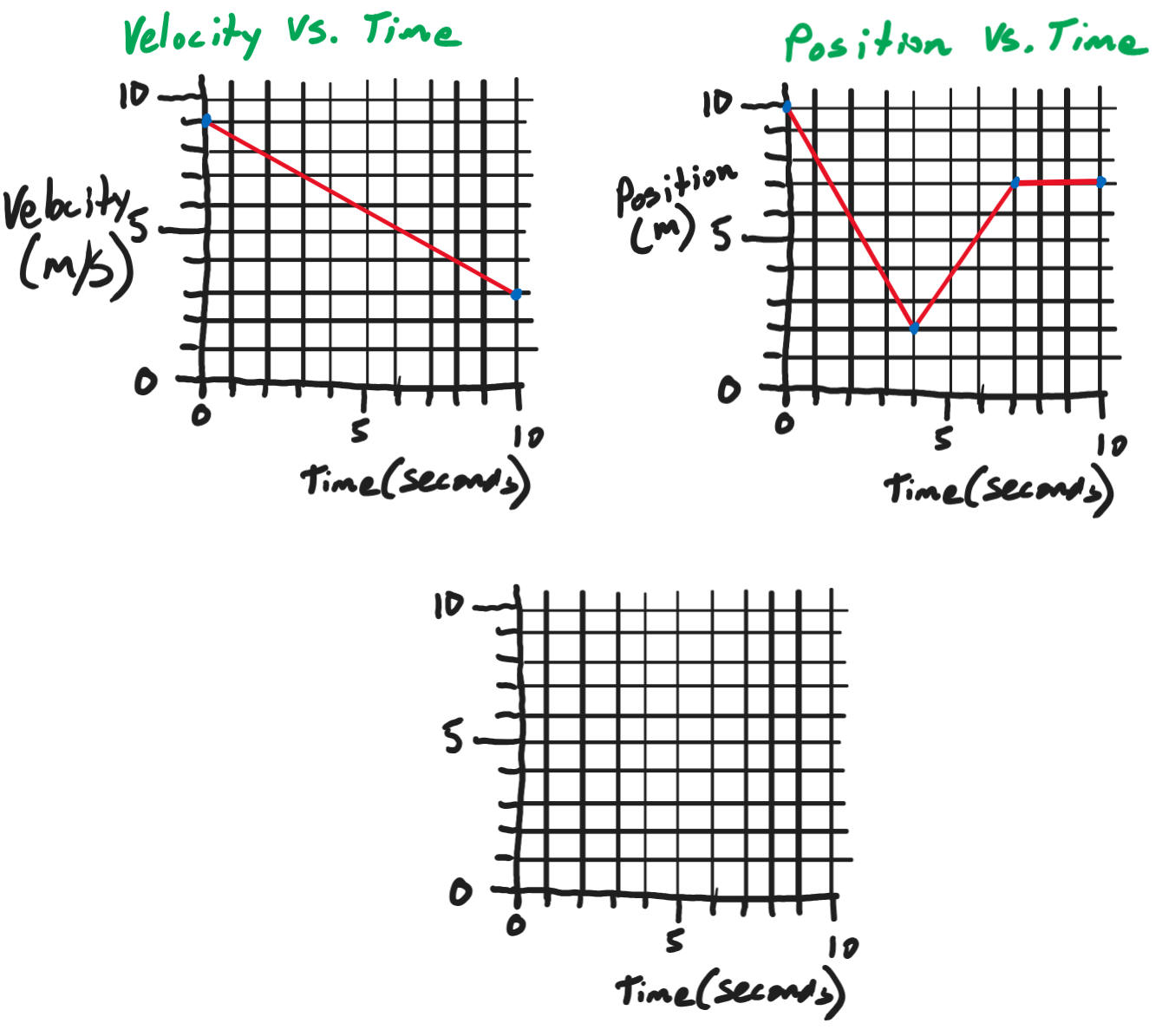
1
. On the velocity vs. time graph, find v0, v, and average v.2. On the position vs. time graph, find: total displacement, total distance, average velocity, maximum speed, and minimum speed.
3. Let's do some more practice to get ready for the quiz.
Today:
- Quiz -- Distance, Displacement, Change in Time, Speed, Average Velocity (both formulas) Video of Quiz REview
- Unit 1 (Motion) Handout (PDF)
- Motion Matching Activity -- p. 7
Until Next Class: Have a great weekend! Review to retake the quiz if you want to.
 Class
3:
Wednesday, 9/3/25
Class
3:
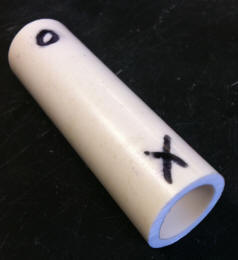
Wednesday, 9/3/25Warm Up:
Spin one of the "sprotating cylinders" by pressing one end until it squirts out from under your finger. Try pressing the other end.
When the cylinder is spinning, why do you only see the symbol that you press?
Today:
- Physics Stuff:
- Quick Review of notes from last class. Try out links (e.g. video).
- Velocity Practice (p.3-4) Video
- Practice Quiz Video
- Unit 1 (Motion) Handout (PDF)
- Notes: p5 (acceleration)
- Prepare for the Quiz -- what do we need to do to get you feeling comfortable? More practice problems?
- Other stuff:
- Preview -- Course Expectations; look at other years
Until Next Class: Quiz next class, similar to today's practice quiz. You will get another chance to take the quiz and improve your grade.
Quiz Learning Targets (highlighted in yellow, below):
CVM.x - I can draw and interpret diagrams to represent the motion of an object moving with a constant velocity
CVM.x - I can solve constant velocity problems
CAM.x - I can draw and interpret diagrams to represent the motion of an object moving with changing velocity
CAM.x - I can solve constant acceleration problems.
CAM.x - I can solve kinematic equations
 Class
2:
Friday, 8-29-25
Class
2:
Friday, 8-29-25Warm Up:
How do dragsters go so fast?1. What kind of rear tires do dragsters use?
2. Why do drivers do a "burnout" before each race?
3. How else do dragsters increase traction?
4. What do dragster tires look like in slow motion?
5. Why and how do vehicles "pop wheelies?"
Today:
- Physics Stuff:
- Get the Unit 1 (Motion) Handout (PDF)
- Notes p. 1-2 and some practice on p.3 -- position, displacement, velocity, and more Filled-In Notes Video From Class
- Analyzing Spool Car Videos -- find the winner (Video folder)
- How could we get a constant velocity video?
- Practice Quiz?
- Other stuff:
- Preview -- Course Expectations; look at other years
Until Next Class: Have a great Labor Day weekend!
 Class
1:
Wednesday, 8-27-25
Class
1:
Wednesday, 8-27-25Warm Up: What is a spool car? How does one work?
Today:
- Enter attendance
- Talk about arriving and leaving on time
- Fill out Information Sheet
- Mr. Stapleton slideshow?
- Learn names/pronunciations
- Spool Cars -- so we can have some motion data to analyze
- In groups of no more than 3, assemble a spool car. Directions and information are provided in this Instructable
- Practice and/or reconfigure the car to make it go as fast as possible over the 5 meter long course.
- Get a video made of your car traveling from one blue tape to the other -- Mr.Stapleton will do it.
- Preview -- Course Expectations; look at other years
Homework: Think about this -- what thing moves at at constant velocity? The spool cars accelerate. What could we use in the classroom for collecting constant speed data?